Loading
Tiny homes
Tiny homes built to scale.
Most tiny home builders are bottlenecked by handcraft. CoGrid scales tiny home production with industrialised parts, designed for repeat manufacturing without losing the design flexibility tiny homes are built on.
Search demand for tiny home companies in Australia has surged 900% year on year. Affordability pressure, downsizing, and granny-flat reform are all driving the segment.
The constraint on the tiny home industry is the same as every other small-volume builder: production doesn't scale. Each tiny home is essentially handcrafted. Crews can't run multiple builds in parallel without losing margin.
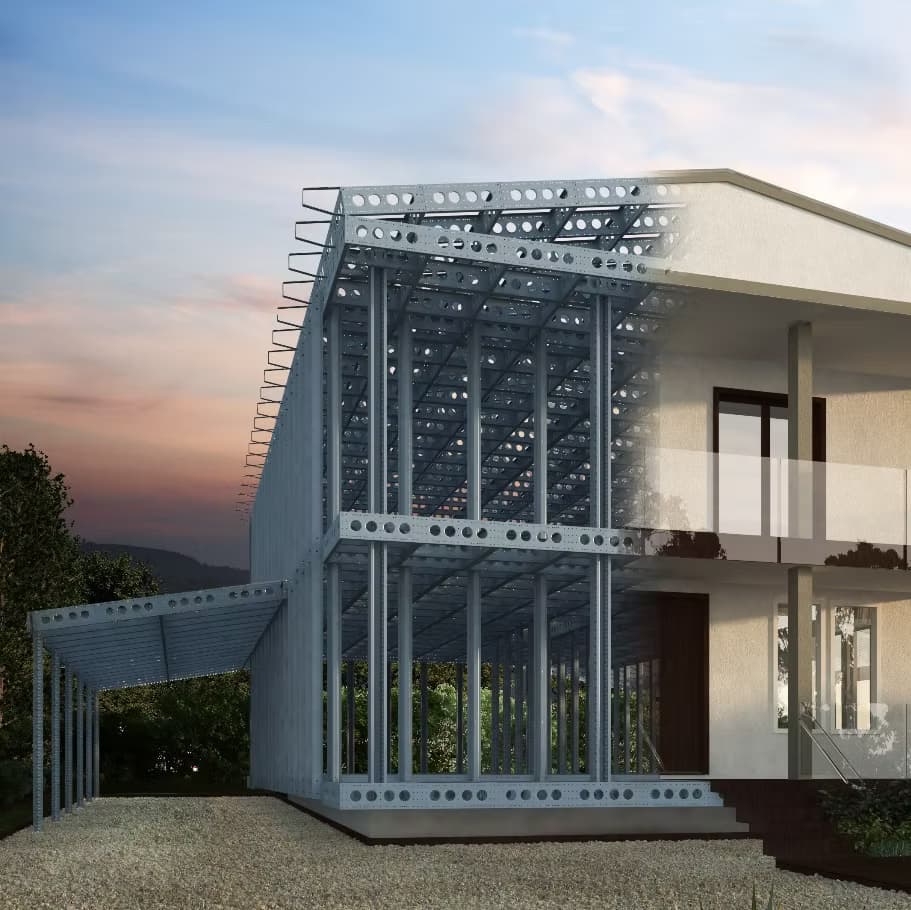
CoGrid is the structural platform that lets tiny home builders run an industrial cadence without giving up design flexibility. The same three-component chassis configures into single-room studios, multi-room dwellings, and dual-occupancy designs. Bolted assembly. Ground-level work. Repeatable build sequence per unit.
For a tiny home builder running a steady programme, that's the difference between margin per unit and margin at scale.
- Industrialised steel chassis — repeatable build cycle per unit
- Configurable design language — studios, multi-room, dual-occupancy
- Suitable for transportable and on-site tiny homes
- Engineered for compact footprints with multi-storey-capable chassis
- Compatible with secondary-dwelling planning frameworks
Frequently asked
Common questions about tiny homes.
What size tiny home does CoGrid suit?
Single-room studios up through multi-room dwellings — the chassis grid scales up and down. Smaller footprints work well; CoGrid wasn't designed only for big builds.
Can it be on a trailer chassis?
The CoGrid steel chassis is designed for on-foundation builds (slab, gravel, footings). For trailer-based tiny homes a specialist trailer chassis is more appropriate. We're happy to discuss hybrid configurations.
Related sectors
See how this fits across CoGrid's sector configurations.
Tiny homes
Scale your tiny home programme
If you're a builder running a tiny home programme, we'll work out what CoGrid adds to your unit economics.