Loading
Granny flats & secondary dwellings
Granny flats and secondary dwellings, on demand.
Secondary dwellings are the fastest-growing residential segment in Australia. CoGrid is the structural platform that lets builders run them as a repeatable product, not a one-off project.
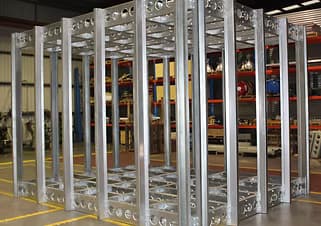
Granny flats — also called secondary dwellings, ADUs, and dual-occupancy units — are at the centre of Australia's housing-supply response. Most state planning frameworks now permit secondary dwellings on existing residential lots without the full DA process, which has unlocked a wave of demand.
Builders who can deliver secondary dwellings reliably and at programme are well-positioned. The constraint is unit economics. Each granny flat is a small build, with the same site setup, services, and trades coordination as a much larger dwelling.
CoGrid changes the maths. The chassis is buildable by a small crew without specialist trades, ships flat-pack, and assembles fast. For a builder running a steady granny-flat programme, the structural cost-per-unit drops, the schedule per unit tightens, and you can run more units in parallel without losing margin.
- Single-storey and two-storey secondary dwelling configurations
- Bolted assembly — accessible to small residential crews
- Compatible with state secondary-dwelling planning frameworks
- Repeatable build cycle — better unit economics on volume programmes
- Multi-storey-capable for elevated or stacked secondary dwellings
Frequently asked
Common questions about granny flats & secondary dwellings.
Does CoGrid suit elevated granny flats (e.g. above a garage)?
Yes — the chassis is multi-storey native and handles elevated configurations including over garages and carports. Engineering certification is provided per design.
What's the typical build time for a secondary dwelling?
Structural shell programmes are typically days, not weeks. Total build time depends on services and fit-out. The structural critical path is no longer the bottleneck.
Related sectors
See how this fits across CoGrid's sector configurations.
Granny flats & secondary dwellings
Cost a secondary-dwelling programme
If you're a builder running secondary dwellings, we'll work out what CoGrid does to your per-unit economics.